The international air freight industry demonstrated remarkable resilience and underwent structural changes in a complex environment over the past year. The following are the key current affairs that impacted our core routes (South Korea to Europe/US):
1. Geopolitics & Tariff Policies Became the Primary Variables
Ongoing Adjustments to U.S. Tariff Structures: The strengthening of U.S. tariff barriers on specific categories (particularly EV components, high-end electronics) from Q2 2025 solidified the "South Korea Transit & Assembly" model as a critical supply chain risk-aversion pathway.
Full Implementation of EU CBAM: The formal operation of the Carbon Border Adjustment Mechanism led to a surge in demand for logistics solutions involving green leg transshipment via Incheon Airport.
2. Deep Reshuffling of Capacity Landscape
Expanded China-South Korea Air Rights Released Dividends: During the 2025 Summer/Autumn flight season, 42 additional weekly cargo flights were added between China and South Korea. Flight frequency on our core Incheon-AMS/LHR/LAX routes increased to over 18 flights per day on average.
Entry of New Aircraft like the C919: The deployment of domestically produced aircraft on Asia-Pacific routes provided more cost-effective capacity options for shipments originating from South Korea.
3. E-commerce Driving Structural Demand Shifts
Intensified Logistics Speed Competition Among Platforms: Platforms like Amazon and Temu established "4-day delivery" as a standard service in key European markets (especially around AMS and LGG), fueling sustained demand for high-density air charters throughout the year.
Prolonged Peak Seasons: Traditional peaks (Prime Day, Black Friday/Cyber Monday) overlapped with emerging market shopping festivals, creating "wave-like" shipping demand.
4. Green Logistics Evolved from Initiative to Compliance
Enactment of EU Aviation Emission Reduction Laws: Flights to EU airports (e.g., AMS, LGG) faced clear Sustainable Aviation Fuel (SAF) usage mandates.
Explicit Client ESG Requirements: Over 60% of B2B clients explicitly requested carbon emission data and reduction plans in their tenders.
5. Digitalization & Resilience Became Standard Infrastructure
Substantial progress in global air cargo digitalization initiatives, with blockchain-based air waybills piloted on South Korea-Europe/US routes.
Black Swan events like the Red Sea Crisis prompted companies to adopt "Multimodal Transport + Emergency Air Freight" as a standard supply chain configuration, keeping utilization of our Incheon emergency transshipment warehouse high throughout the year.
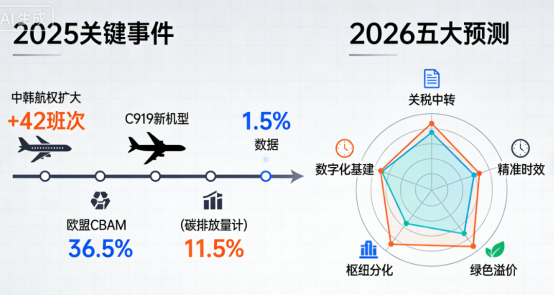
Based on current trends and policy directions, we forecast the following for the 2026 South Korea-Europe/US air freight market:
Prediction 1: Tariff-Driven Transshipment Logistics Becomes Routine
South Korea's Role as a Manufacturing Hub Strengthens: More Chinese companies are expected to establish light assembly centers in South Korea to leverage its Free Trade Agreement advantages with Europe and the US. Our "Tariff-Optimized Transshipment Solution" at Incheon Airport will become essential.
Key Categories to Watch: Transshipment demand for lithium batteries, semiconductor equipment, and high-end consumer goods is projected to grow over 30%.
Prediction 2: Accelerated Tiering of Precision Time-Definite Products
Polarization Between "Same-Day" and "Economy": Ultra-fast "24-hour door-to-door" products for e-commerce parcels to LAX will emerge, while "5-7 day economy air freight" for pre-consolidated cargo will capture market share from traditional ocean freight.
Proliferation of Predictive Logistics: AI-based shipment volume forecasting will be deeply integrated with space booking, highlighting the value of locking in peak-season rates in advance.
Prediction 3: Green Premium Becomes a Competitiveness Metric
SAF Usage Ratios and Cost-Pass-Through Mechanisms Mature: Routes to airports with strict environmental requirements (e.g., AMS) will offer integrated "Green Surcharge - Carbon Reduction Certificate" solutions.
End-to-End Carbon Data Visibility becomes a threshold requirement for major clients selecting logistics partners.
Prediction 4: Further Functional Divergence Among Hub Airports
Intensified Competition in E-commerce Processing at AMS & LGG: European gateway airports will invest in automated sorting centers. Having pre-positioned VIP customs clearance channels, we expect a further 20% reduction in clearance times.
LAX Consolidates its Position as an Asia-Pacific Fresh Gateway: Demand for weekly scheduled temperature-controlled air freight will rise alongside growing exports of Korean high-end agricultural products and health supplements.
Prediction 5: Digitalization Transitions from "Option" to "Infrastructure"
End-to-End Visibility Becomes Standard: Real-time tracking of temperature, humidity, location, and customs status—from pickup in Incheon to final delivery in Europe/US—will become a basic service.
AI-Driven Dynamic Route Optimization: Intelligent routing systems accounting for weather, congestion, and strike risks will help clients reduce unexpected delays by over 30%.
In the face of profound industry changes, we have proactively built three core capabilities to help our clients navigate 2026 opportunities:
1. Deeply Optimized Network Resilience
Dual-Hub Backup System: Complementing our primary Incheon hub, we added a Busan emergency operations center, ensuring cargo can be consolidated from anywhere in South Korea within 72 hours amidst geopolitical fluctuations.
Diversified EU/US Port Matrix: Beyond our core hubs (AMS, LHR, LGG, LAX), we established priority service agreements with FRA (Frankfurt) and ORD (Chicago), providing flexible alternatives.
2. Dual-Driven by Green and Digital Initiatives
Productized Low-Carbon Routes: We have achieved the use of 20% SAF-blended fuel on our Korea-AMS routes, providing clients with certifiable carbon reduction reports.
3. Upgraded Customized Solutions
For High-Tariff Categories: We offer a one-stop "Tax-Advantaged Direct" service covering Korean origin certification, compliant packaging, to bonded zone transshipment.
For E-commerce Clients: We introduced a "Peak Season Capacity Insurance" service, allowing clients to lock in fixed space and rates during peak periods for a small premium.
Embracing 2026: Let's Redefine the New Standards of Efficiency and Resilience Together.
In the face of a complex and volatile global trade environment, relying on a single transportation solution is a thing of the past. Eastation Logistics, with our deep expertise and forward-looking strategy on Korea-Europe/US routes, is committed to being your most reliable air supply chain partner.
Keywords: 2026 Air Freight Trends, South Korea Air Freight to Europe/US, AMS Air Freight, LHR Cargo, Tariff Transshipment Solutions, Sustainable Aviation Logistics, Eastation Logistics